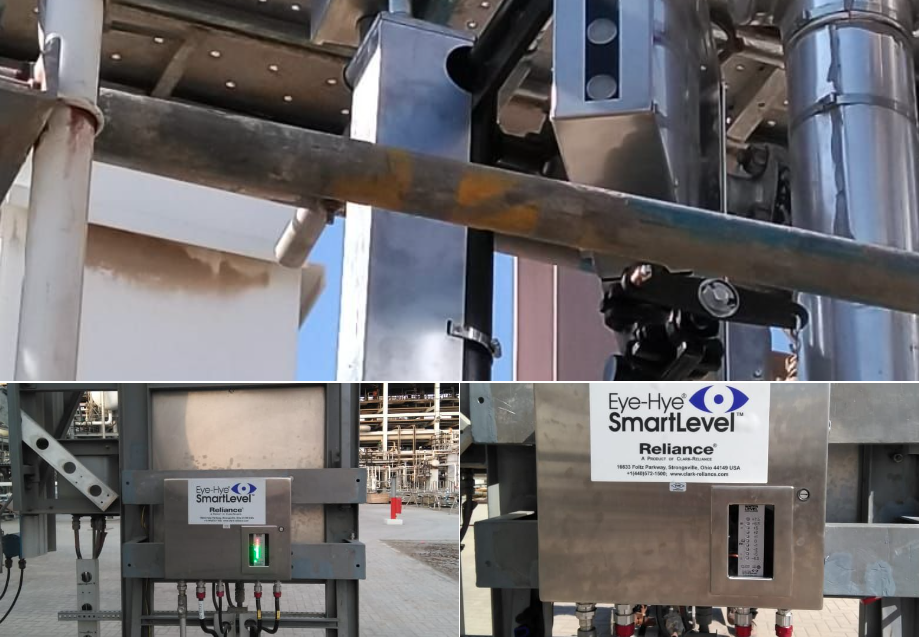
Preventing Boiler Drum Level Instrumentation Code Violations
Updated: Aug 6
According to The National Board of Boiler and Pressure Vessel Inspectors, boiler controls account for the highest percentage of total documented boiler and pressure-vessel-inspection violations. The reasons are varied — neglect, improper maintenance procedures, isolation or elimination of necessary code-required instruments and accessories, and unauthorized piping modifications all contribute.
Reliance Boiler Trim Product Manager Jim Kolbus addressed this exact problem in a published article, outlining proactive steps plant-level users can take to reduce the risk of violations related to water-level instrumentation — violations that threaten the safety of both personnel and equipment.
The Code Requirement Baseline
For every power boiler designed to comply with Section I of the ASME Boiler and Pressure Vessel Code, water-level gauge glasses are required.
Boilers operated at pressures up to 400 PSI: At least one water gauge glass in continuous service is required.
Boilers operated at pressures over 400 PSI, one of the following is required:
Two water gauge glasses in continuous service, visible from the control area
One water gauge glass combined with two independent level transmitters continuously visible to the operator in the control area (the gauge glass may be isolated as long as it's kept in working condition, in case it's needed to verify a level-transmitter reading)
One gauge glass with transmission of water level to the control area by camera, fiber optics, or mirrors in continuous service, combined with a separate level transmitter
The Underlying Logic
If one or more water gauge glasses are not continuously visible, two separate level transmitters are required instead. Consider the reasoning: if an operator had only one level transmitter indicating water level, how would they know the displayed information is accurate? If two transmitters are continuously visible, indicate similar levels, and track together as water level changes, the operator can have genuine confidence in the reading. This is why proper care and operation of these instruments is paramount for safe boiler operation.
Ensuring Proper Water Gauge Glass Function
Keep It Clean, Illuminated, and Properly Oriented
The gauge glass should be kept clean, illuminated, and oriented for easy observation by the operator. A gauge that's technically functional but hard to see doesn't serve its safety purpose.
Perform Blowdown as Recommended
Perform blowdown as recommended by the instrument manufacturer or plant rules. When conducted properly, blowdown reduces the risk of sediment buildup in the piping that delivers water from the drum to the indicating glass or instrument.
Use Genuine OEM Component Parts
The risk of premature leakage increases when components that don't meet OEM specifications are installed in water gauge glasses or level instruments. As one specific example: a neoprene-rubber-type packing ring intended for low-temperature water will not survive high-pressure steam service if installed in an isolation valve rated for that duty. Substituting non-OEM parts to save time or cost can introduce exactly the kind of failure mode a code-compliant installation is designed to prevent.
Inspecting Other Level-Indicating Instruments
Beyond the gauge glass itself, other level-indicating instruments should be inspected regularly for:
Loose wiring
Leaks associated with piping connections, isolation valves, and sensors
Insulation missing from the steam and water piping between the drum and instrumentation
Why Insulation Matters More Than It Seems
Properly installed piping insulation reduces burn risk to personnel. But it also reduces the negative effects of cooling, which can cause false low-level indication due to density differences between the water in the drum and cooler water in the instrument. Insulation also reduces excess condensate formation in steam piping — condensate that has been shown to accelerate wear on instrument internals and their connections.
Staying Current on Manufacturer Guidance
Most level-instrument manufacturers offer detailed maintenance instructions online, eliminating guesswork around procedures and frequency. As materials improve and instrument technology evolves, it's worth contacting the manufacturer directly for the latest technical information whenever doubts about servicing arise, rather than relying on outdated documentation.
Beyond the Basics: Additional Code Factors
This overview covers the core code requirements, but there are additional factors that affect compliance:
The placement of an instrument's indicating range relative to the nozzle connections on the drum
Boiler code minimum pipe size rules for instrument connecting and drain piping, including pressure limits for various threaded connection sizes
Limitations on the application of certain instrument types
Specifications for pressure part materials — piping, castings, and permissible stainless steel grades
Isolation valve requirements
Placement of level-alarm and low-water-cutout devices
Exceeding Minimum Requirements
Plant owners are encouraged to consult with their insurance carrier or safety director to determine the number and types of level instruments required for their specific plant. The ASME Boiler and Pressure Vessel Code details minimum requirements, but individual plant specifications often exceed those minimums.
This is a deliberate risk-reduction strategy: users can prevent violations by exceeding the minimum number of instruments required by code. If one instrument goes out of service for maintenance, the plant may still have enough remaining instrumentation in operation to stay in compliance.
Additional Code References
For more detail, consult:
ASME Boiler and Pressure Vessel Code, Section I, "Power Boilers"
ASME Boiler and Pressure Vessel Code, Section VII, "Care of Power Boilers"
ASME CSD-1, "Controls and Safety Devices for Automatically Fired Boilers"
Clark-Reliance's "Boiler Inspection Guidelines for Drum Level Instrumentation per Section I of the ASME Code"
Learn More
Clark-Reliance's boiler trim specialists, including Jim Kolbus, are available to discuss code compliance strategy and instrumentation maintenance for your specific facility.
📧 sales@clark-reliance.com📞 +1 (440) 572-1500